Heart Arrow: A Thoughtful Embroidery Design for Real Projects
First Impressions That Stick—Not Just for February
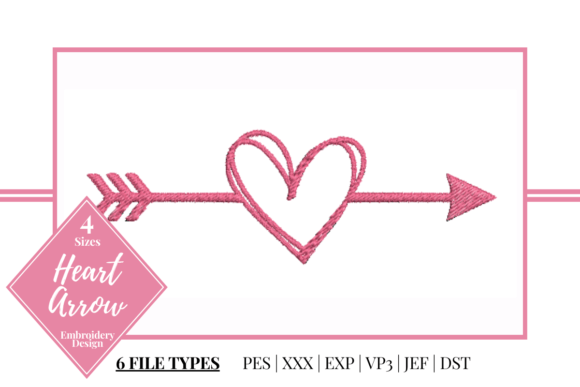
When I opened Heart Arrow for the first time, I didn’t see “Valentine’s Day cliché.” I saw clean lines, balanced negative space, and a subtle confidence in its simplicity. It’s not fussy or overly ornate—no swirls, no lace motifs, no tiny hearts orbiting like satellites. Just a heart pierced cleanly by an arrow, shaped with intention. The curves are smooth but not saccharine; the arrowhead has just enough weight to feel grounded. It reads as modern, warm, and quietly romantic—not loud, not ironic, not trying too hard. That’s rare in holiday embroidery files, especially ones meant for commercial use.
Where It Lives Best: From Tote Bags to Tiny Onesies
I tested Heart Arrow on three real projects: a heavyweight cotton tote bag for a local boutique, a soft organic-cotton baby onesie, and a structured twill apron for a chef friend’s small shop. On the tote, it stitched crisply at 3.8" wide—no puckering, no thread breaks. The satin stitch along the heart’s outer edge held its shape beautifully against the fabric’s slight texture. On the onesie? I used lightweight tear-away stabilizer and reduced top tension slightly—still sharp, still legible, even at 2.2". And on the apron? No hooping drama. The design’s compact footprint (no sprawling vines or trailing elements) made it easy to position precisely over the pocket without crowding seams.
This is where Heart Arrow earns its keep: it’s versatile *without* being generic. It works as a standalone embroidered patch, a subtle chest accent on a sweatshirt, a centered motif on a tea towel, or a delicate detail on nursery decor. It doesn’t scream “holiday”—so it won’t look dated in March. That matters if you’re an Etsy seller building year-round collections or a craft business curating boutique branding.
Where to Pause—and Why
That said, Heart Arrow isn’t bulletproof on every surface. On thin, stretchy fabrics like jersey or lightweight rayon, I recommend basting + cutaway stabilizer—especially around the arrow’s narrow shaft. Without support, the running stitches there can shift or distort. On dark fabric, test contrast early: the inner fill areas are dense enough to hold up, but if your thread colors are low-contrast (e.g., burgundy on navy), details blur. Also avoid placing it directly over thick seams or curved cap fronts unless you’ve confirmed hoop clearance—the arrow’s clean angles don’t forgive distortion.
It’s not an applique design, so don’t expect raw-edge charm or layered fabric interest. It’s a machine embroidery design built for precision, not texture play. If your brand leans into rustic, hand-stitched aesthetics, this may feel too polished. But if you value clarity, consistency, and clean handmade presentation? Heart Arrow delivers.
What It Adds—Beyond the Stitch
Customers notice subtlety. When I added Heart Arrow to a set of linen pillow covers for a wedding gift, the recipient didn’t say “cute heart.” She said, “It feels intentional—like it belongs.” That’s the quiet power of well-proportioned design. It elevates a basic item into something thoughtful, not themed. For small shop owners, that translates to higher perceived value and stronger brand trust. For Etsy sellers, it means better photo mockups—no distracting elements competing for attention in your printable mockup or digital product preview.
And yes—it photographs well. Clean lines render sharply in both natural light and studio shots. No fuzzy edges, no stitch bleed. That matters when your finished product lives in thumbnails, social feeds, and printed catalogs.
Practical Designer Notes You’ll Actually Use
- Always test on scrap fabric first—especially if stitching on textured weaves or blends. Thread color shifts dramatically across fabric types.
- Check stitch density before scaling. At under 3", the arrow tip stays defined; push past 4.5", and fill stitch saturation may soften definition.
- Confirm hoop size. This design fits comfortably in a 4x4 hoop—but verify your file’s exact dimensions before digitizing for production runs.
- Inspect small details in your embroidery software: the curve where arrow meets heart, the taper of the shaft, the symmetry of the heart’s lobes. These are what separate professional-looking work from “good enough.”
- Test black-and-white mockups. If it reads clearly without color, your customers will recognize it instantly—even in dim lighting or on small tags.
- Use proper stabilizer—lightweight for knits, medium for cottons, cutaway for wovens prone to fraying. Don’t skip it just because the design looks simple.
- Review licensing before selling finished items or bundling the digital embroidery file. Some machine embroidery designs allow personal use only; others permit commercial embroidery or resale of physical products. Clarify before you list.
A Design That Works—Not Just One That Exists
Heart Arrow doesn’t try to be everything. It doesn’t cram in extra flourishes to pad stitch count. It doesn’t lean on trend-chasing motifs. Instead, it does one thing very well: express warmth and connection with restraint. That makes it reliable for custom apparel, trustworthy for baby embroidery, adaptable for holiday embroidery, and commercially sound for craft business owners who need consistent, scalable design assets.
Whether you’re stitching a personalized gift, prepping for a craft fair, or building a cohesive line of embroidered home goods, Heart Arrow holds its own—not as decoration, but as deliberate design choice. And in our world, where every stitch carries intention, that’s worth more than any seasonal label.